
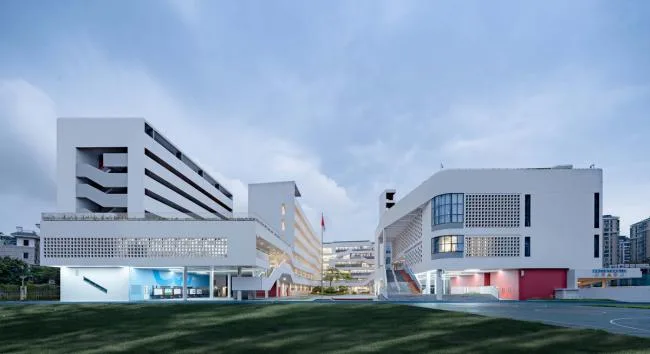
▲ View along the sports field
In recent years, Shenzhen’s rapid urban development has led to highly intensive land use and increasing spatial density. Alongside policy incentives, the city’s population has surged, driving up demand for educational facilities. This evolving landscape has raised the bar for campus infrastructure, requiring buildings to meet diverse educational needs. As a result, designing primary and secondary schools with high plot ratios and densities—referred to as high capacity and high density—has become a pressing challenge in Shenzhen’s urban planning.
Qianhai Third Primary School (now Shenzhen Nanshan Experimental Education Group Liwan Primary School) is located at the base of Dananshan Mountain in Shenzhen’s Nanshan District. Bordered by Moon Bay Avenue to the east, Qianhai Road to the west, Gangqian Road to the north, and a residential community adjacent to the site’s northern edge, the campus spans 13,048 square meters. Initially planned for 24 classes through public bidding, the severe shortage of nearby school places led to an increase to no fewer than 36 classes. This adjustment resulted in a total building area of 33,200 square meters and a plot ratio of 1.7. Given that Shenzhen’s standard plot ratio for primary schools is 0.8, designing a healthy, relaxed, open, and comfortable three-dimensional campus space within these high-density parameters became the core design challenge.
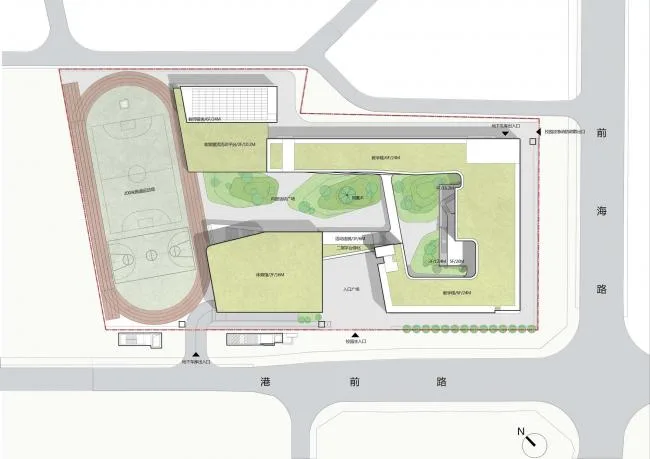
▲ Overall site layout
Layout Strategy
The design prioritizes the relationship between the school and its urban context, organizing the campus along an east-west axis into distinct “teaching-office + living-sports” functional zones with clear dynamic and static areas. The sports field is positioned on the west side, buffering noise from container trucks and traffic on Moon Bay Avenue. The sheltered wind-and-rain playground faces south toward Gangqian Road and adjoins the sports field, offering convenient access for students while minimizing disruption to classrooms. Teaching buildings are located along the quieter north and south edges, with informal and semi-formal teaching spaces concentrated on the eastern side. Faculty dormitories and the student canteen cluster in the northwest, adjacent to the sports field, forming an independent living and sports zone.
To maximize land efficiency under high plot ratio conditions, buildings are placed strategically along site edges following the principle of “golden corners and silver edges.” An underground multi-functional lecture hall with a 300-person capacity frees up courtyard space above, ensuring that all buildings benefit from ample natural light, ventilation, and unobstructed views.
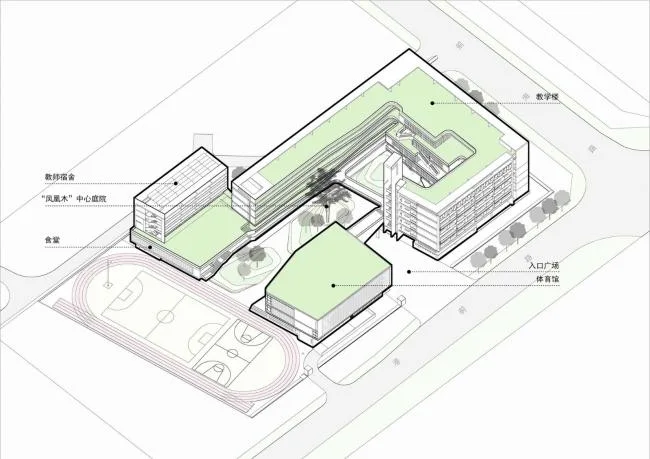
▲ Functional zoning map
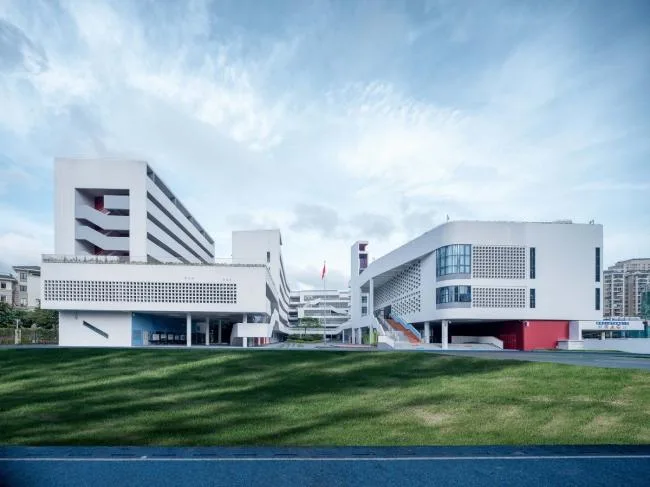
▲ Perspective along the sports field
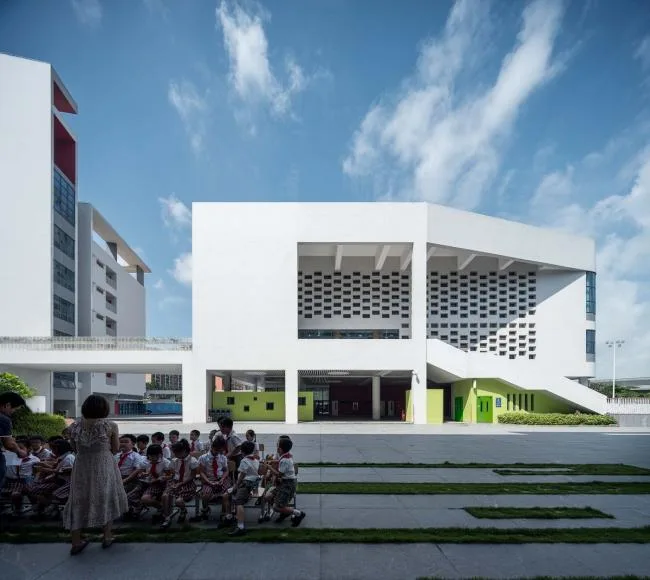
▲ View of the wind-and-rain sheltered playground
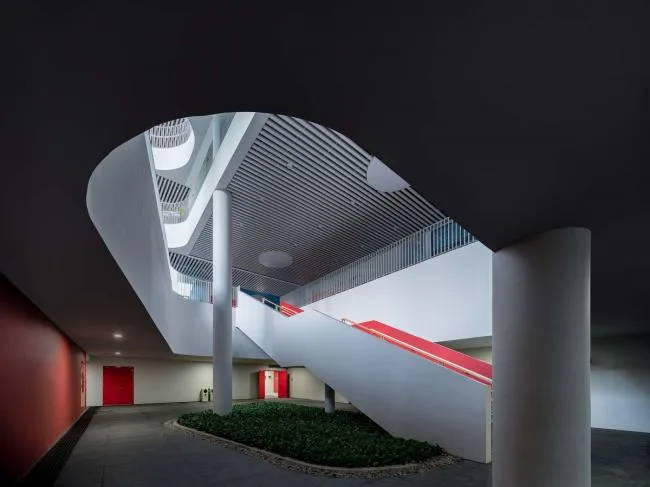
▲ Sunken courtyard of the multi-functional hall
Multiple Courtyards
The campus features three courtyards of varying scale and function, each shaped by the site’s adaptability.
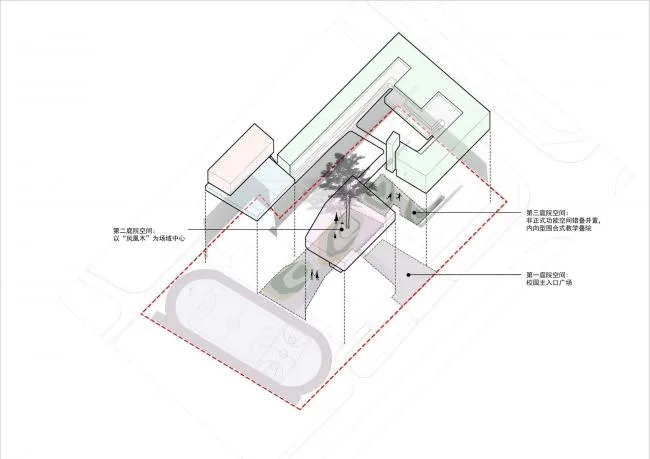
▲ The three distinct courtyards
The first courtyard serves as the main entrance plaza, semi-enclosed by the school gate, wind-and-rain playground, and east teaching building. It acts as a transitional buffer between the city and campus. A multifunctional room on the wind-and-rain playground’s ground floor accommodates parent reception, waiting, and communication, making this courtyard an interactive external showcase for the school.
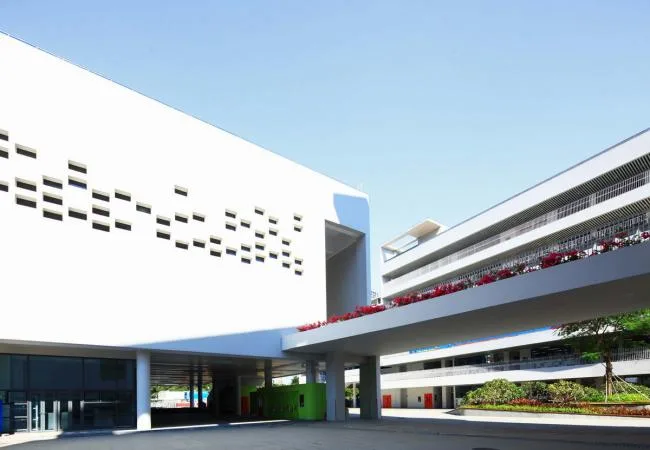
▲ First courtyard view
The second courtyard centers around the “Phoenix Tree,” aligned with the campus entrance axis. It strengthens the connection and extension between the courtyard and the sports field along the east-west axis. Spatial hierarchy and flow are achieved through an outer corridor along the teaching buildings, the elevated base of the wind-and-rain playground, a second-floor platform, landscaped leisure steps, and elevated continuous stairs leading to the cafeteria.
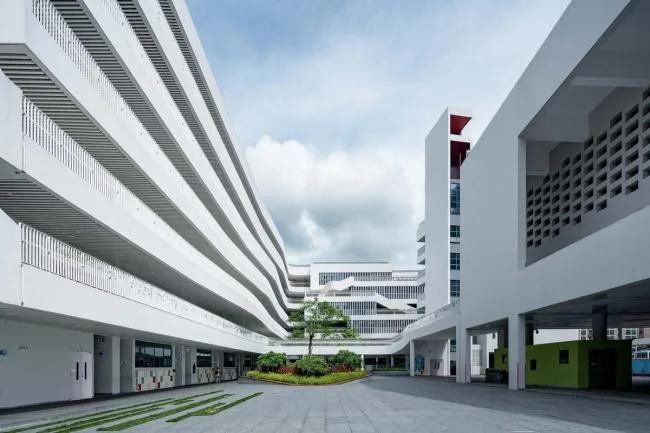
▲ Second courtyard
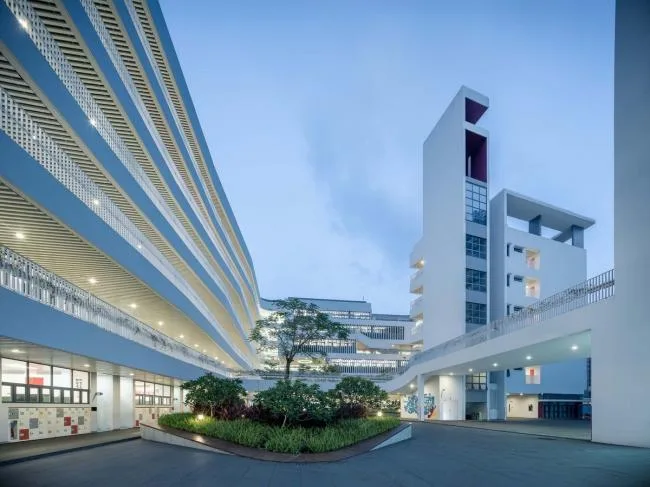
▲ Tree garden
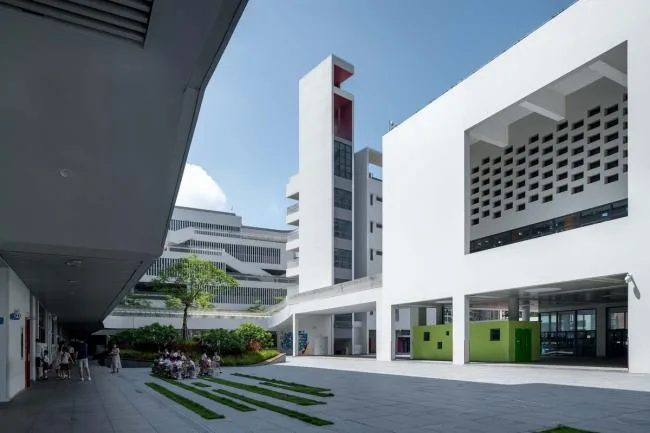
▲ Teaching courtyard
The third courtyard is formed by staggered informal spaces in the middle, creating an inward-facing teaching courtyard enclosed by the north and south teaching buildings. The lower two levels of the central connector are elevated and open to the sunken courtyard of the underground multi-functional hall, generating a continuous, flowing multi-level space above and below ground. Scattered functional boxes and elevated platforms offer students valuable areas for brief activities and social interaction on every floor, encouraging lively engagement and learning.
This informal space is ecologically open, peaceful, and comfortable, guiding the southeast wind into the courtyard while providing distant views of the southern mountain to the east. The third courtyard establishes vertical spatial layers and flow through three-dimensional stacking.
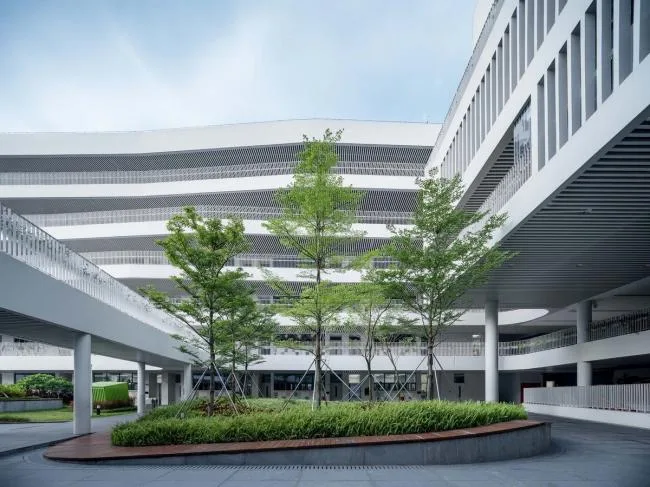
▲ Third courtyard space
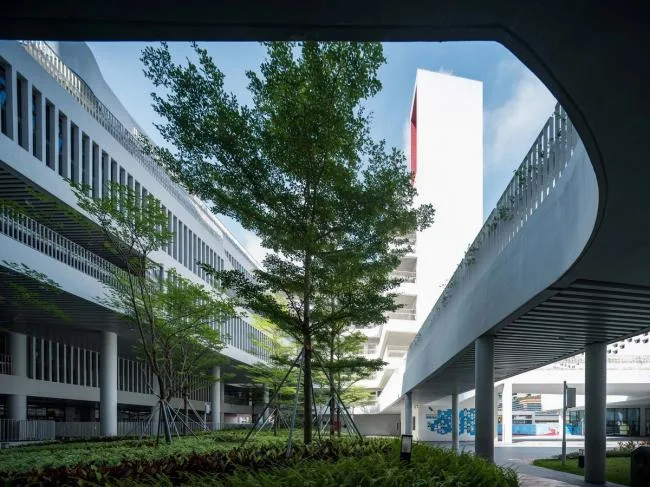
▲ Third courtyard
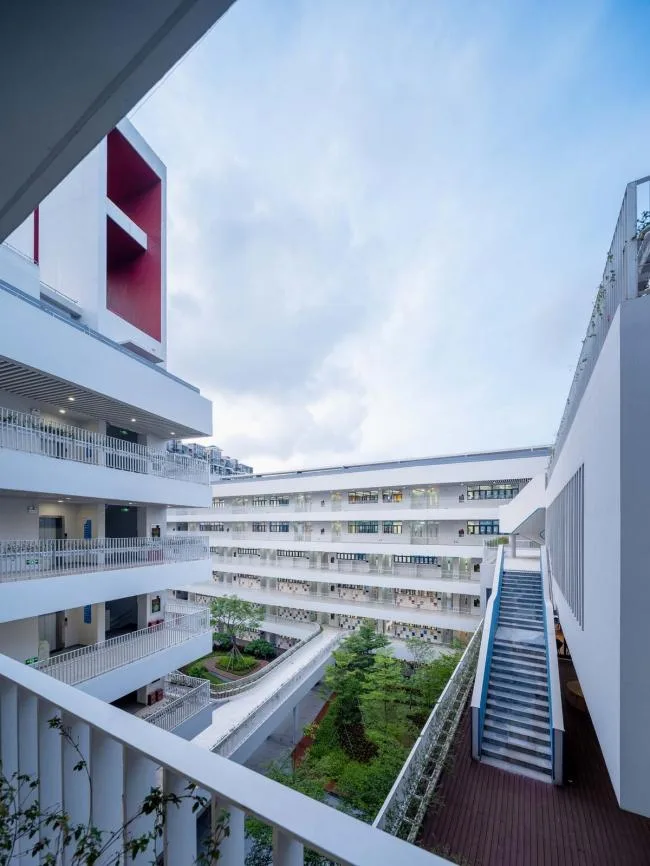
▲ Three-dimensional connectivity within the third courtyard
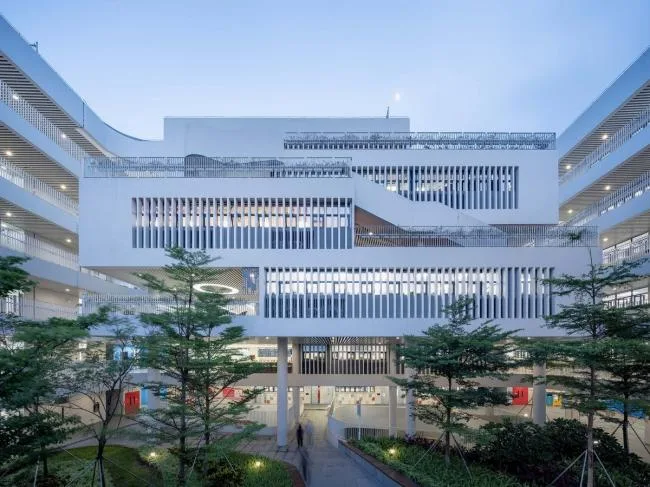
▲ Terrace in the third courtyard
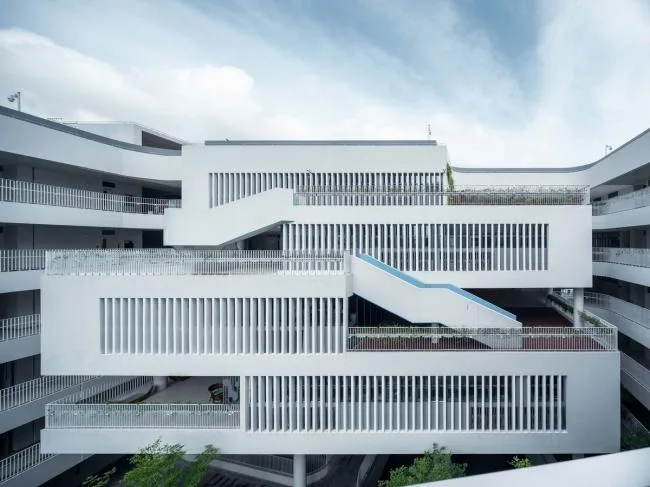
▲ Third courtyard terrace
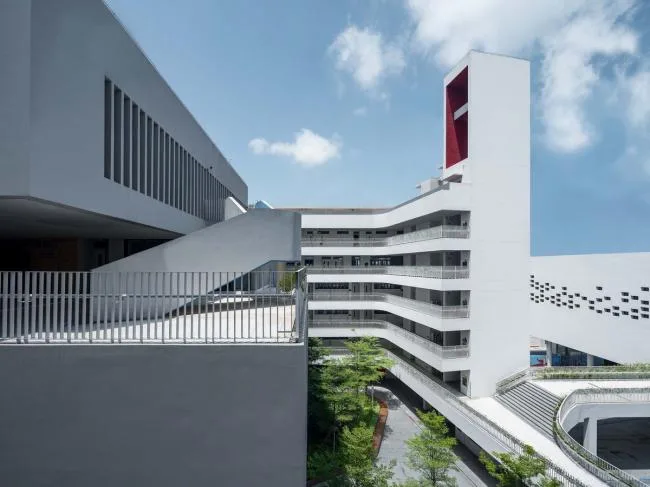
▲ Platform in the third courtyard
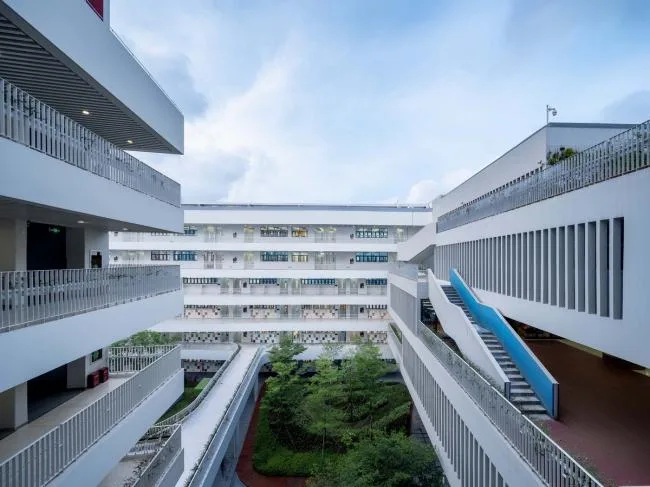
▲ Corridor and platform of the third courtyard
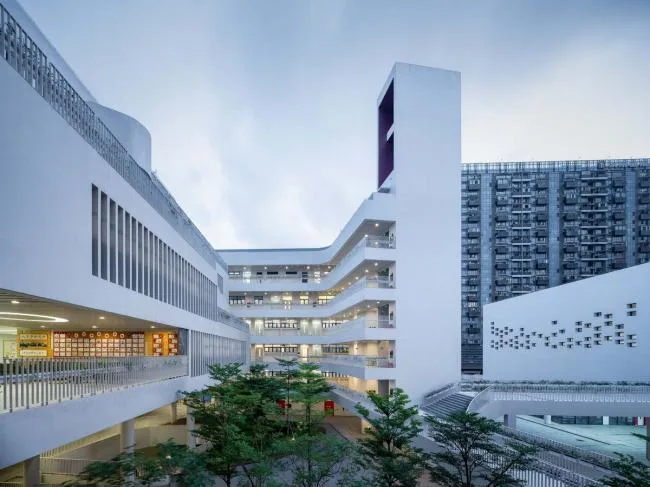
▲ View of the third courtyard from the third-floor corridor
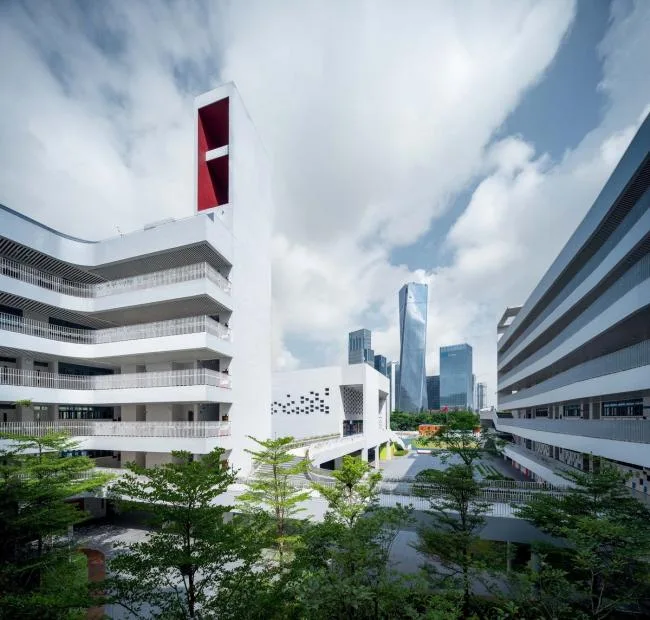
▲ View westward from the third courtyard
By layering, overlapping, and interconnecting these three distinct courtyard spaces—combined with above-ground and sunken courtyards, landscaping, and corridor bridges—a continuous, flowing, transparent, and dynamic three-dimensional public space system has been created. This design fosters a lively and open campus environment.
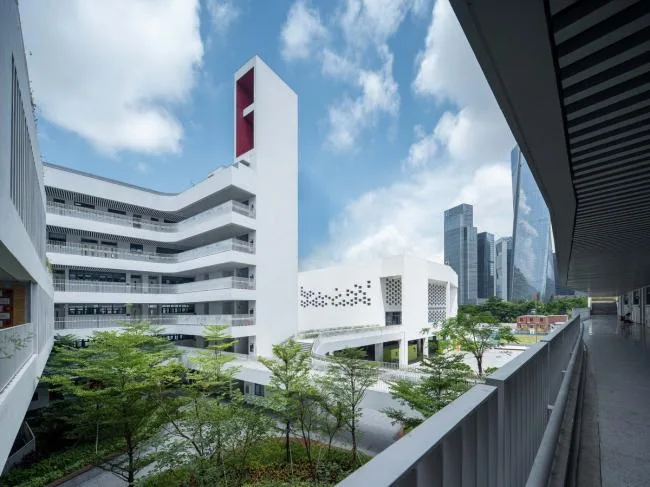
▲ Courtyard visibility
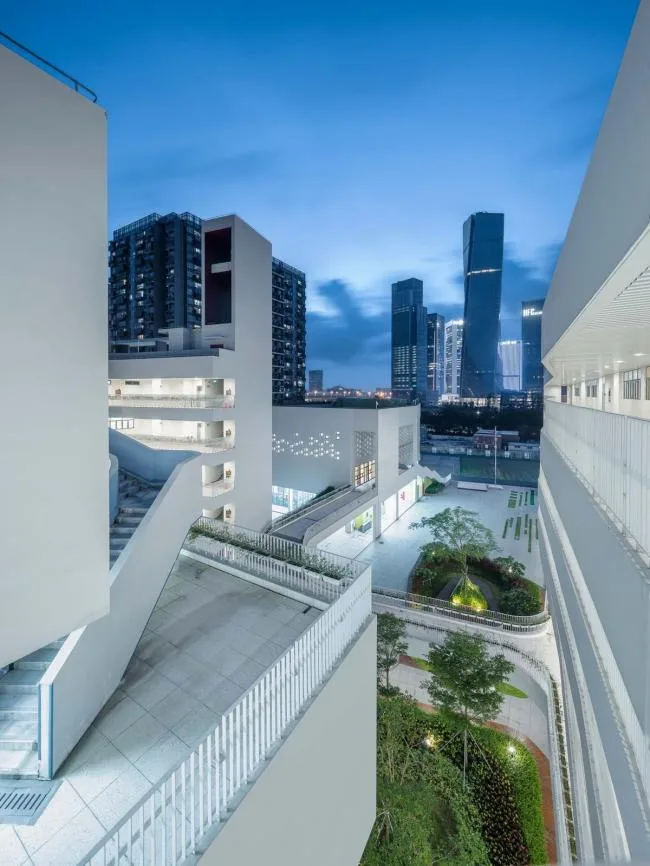
▲ Interactive stacked courtyard design
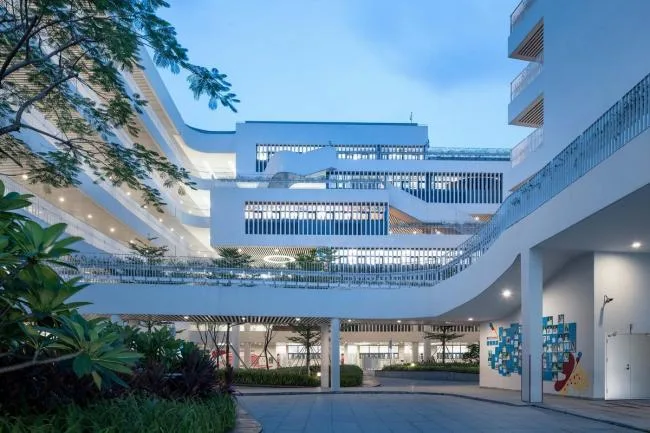
▲ Multi-level courtyard
Multi-Path Circulation
The first floor is partially elevated and connected by corridors, creating a fluid boundary for the courtyard landscape that aligns with students’ movement patterns. This elevation provides continuous shade and shelter from rain, suitable for the southern climate and usable for outdoor activities during wet weather.
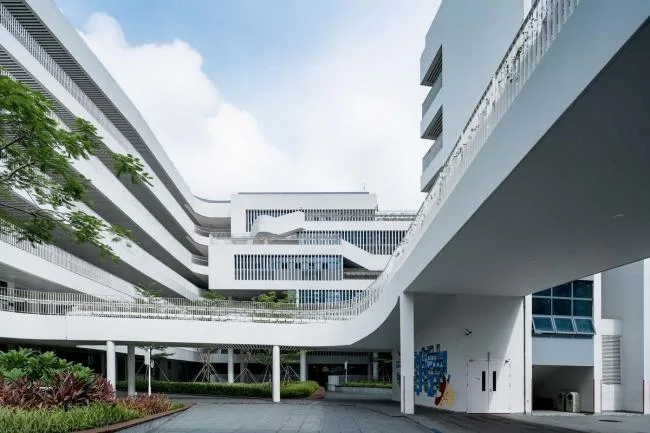
▲ Elevated first-floor corridor
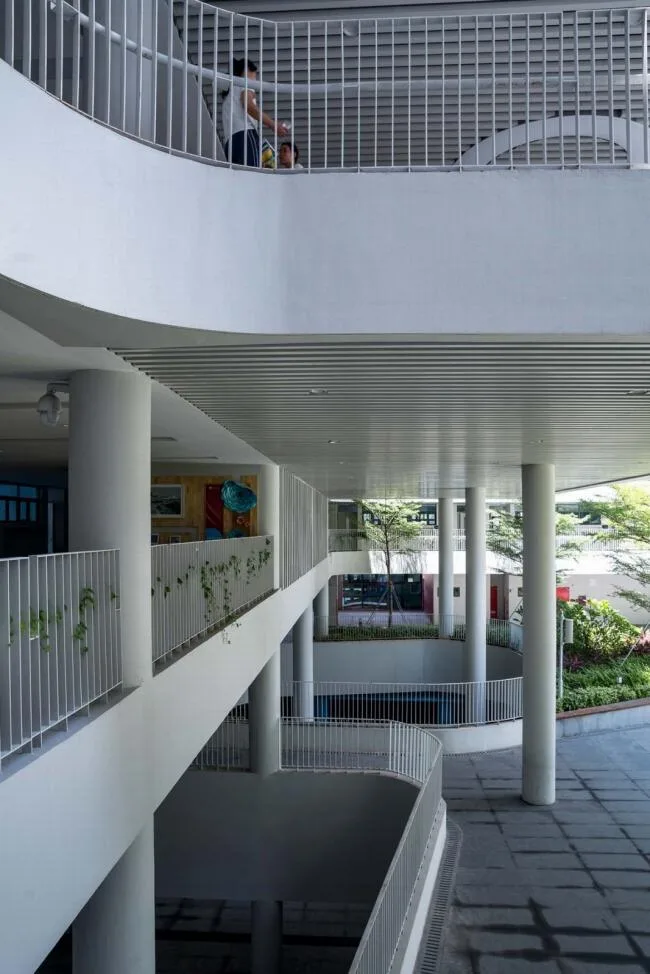
▲ Flow and connectivity of overhead corridors
Intermediate connections link the external corridors of the teaching and office buildings facing the courtyard with informal spaces through various activity paths. These pathways overlap indoor and outdoor, upper and lower levels, fostering interaction and communication. This design enhances layered spatial ambiguity, vertical permeability, and convenient circulation.
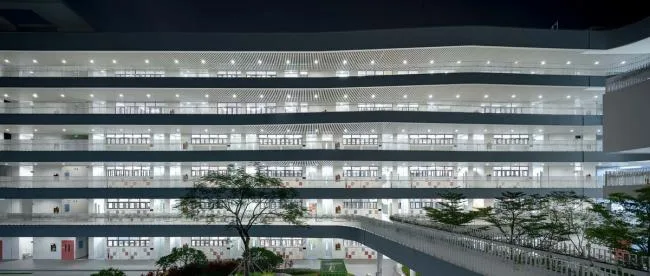
▲ Exterior corridor of the teaching building
An underground traffic diversion center accommodates parents picking up and dropping off children, addressing the constraints of the tight campus site. Shuttle vehicles access a sunken courtyard via an underground ramp to a circular traffic island. Students can then use stairs or elevators to reach the first floor and their classrooms.
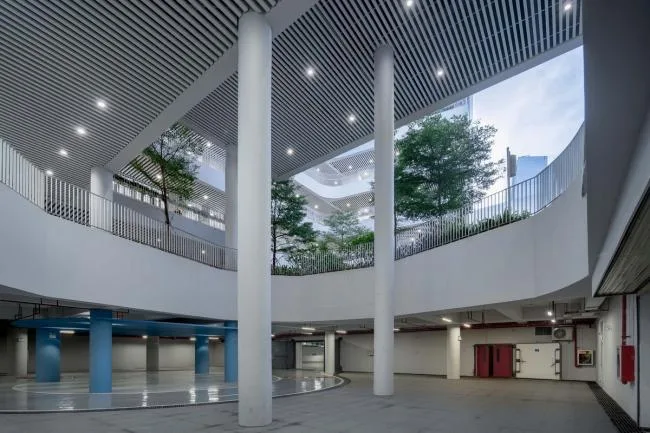
▲ Underground traffic diversion center with elevated sunken courtyard
Emotional Connection to Place
The environment profoundly shapes personality and talent development. This campus embraces learning everywhere, replacing single-purpose corridors with multifunctional open spaces. Blank areas on various floors offer students and teachers opportunities for crafts, calligraphy, painting, and reading.
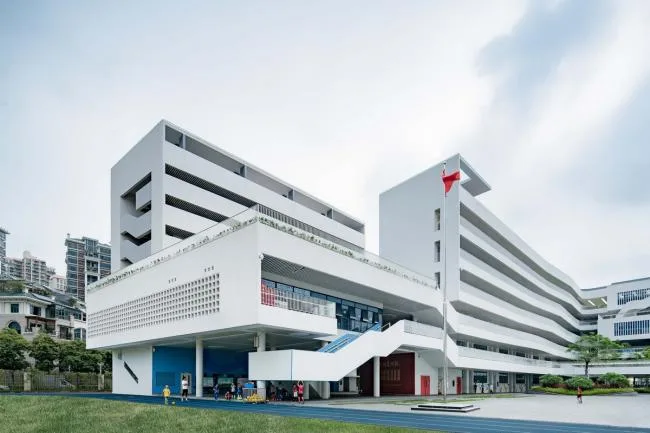
▲ View from the campus northwest corner
The six-year academic journey is a vital period for shaping values and memories. Under the shade of large trees, students enjoy breaks between classes; they cheer on school athletes on broad steps; the library chronicles journeys of discovery. Phoenix flowers bloom and fade in the courtyard, marking seasons of connection and farewell, symbolizing graduation.
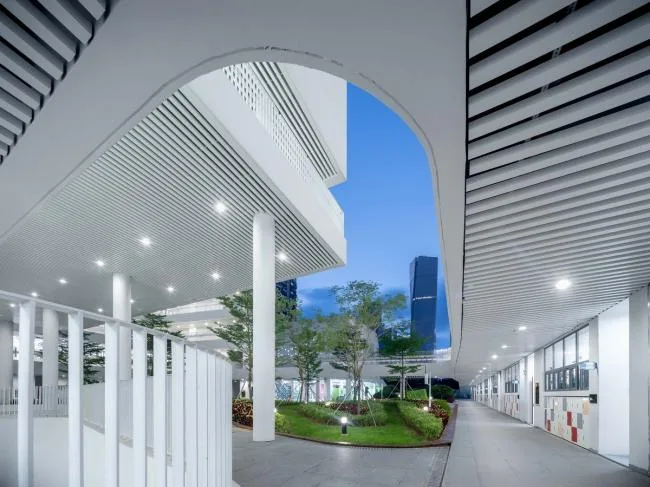
▲ Interior courtyard
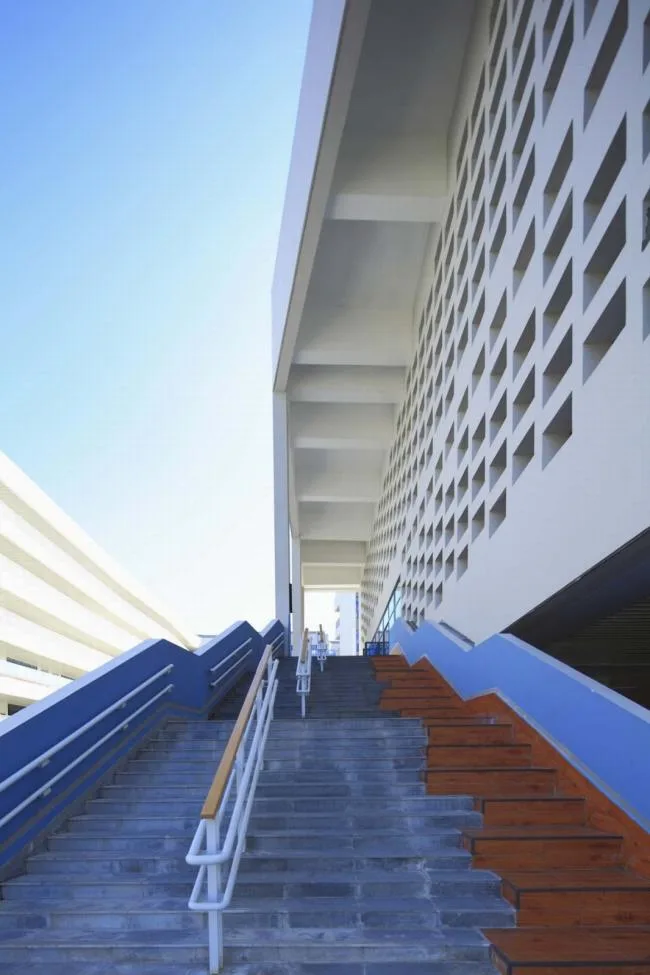
▲ Leisure steps in the sports center
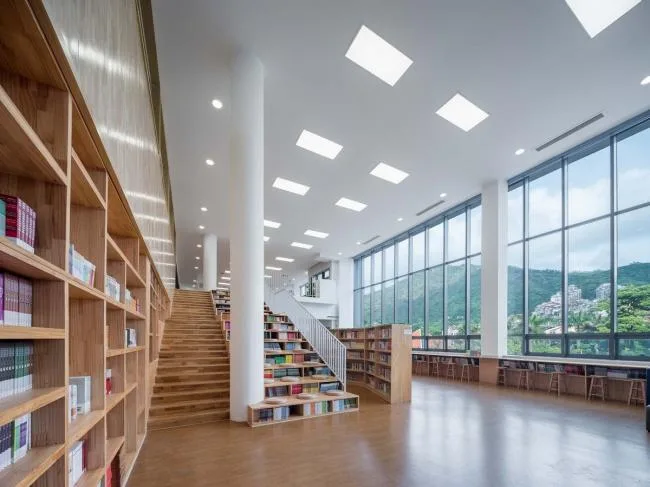
▲ Indoor library space
The architectural spaces blend rational design with a positive spirit. In today’s diverse ideological environment, students are free to interact beyond classrooms. Spacious corridors serve as vibrant communication hubs; mysterious blank spaces under scattered ceilings offer chances for unexpected encounters; large white walls, framed by colorful childlike doors and windows, invite future graffiti and exhibitions. Though neutral, these walls embody tolerance and openness.
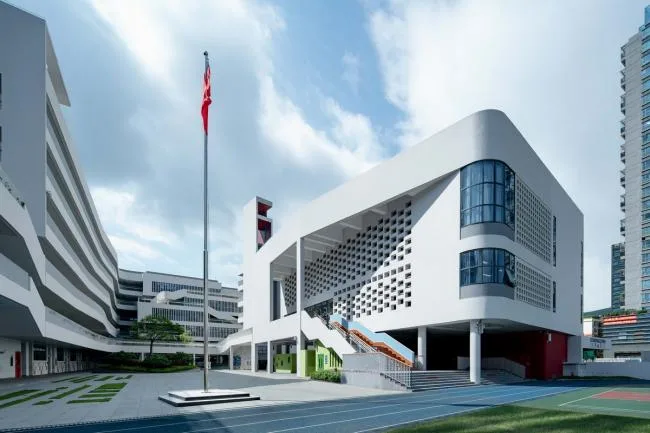
▲ Campus view from west to east
These subtle yet profound experiences plant seeds of beauty, tolerance, and curiosity in young minds, reflecting the hopes of educators and society for the next generation.
Design Drawings
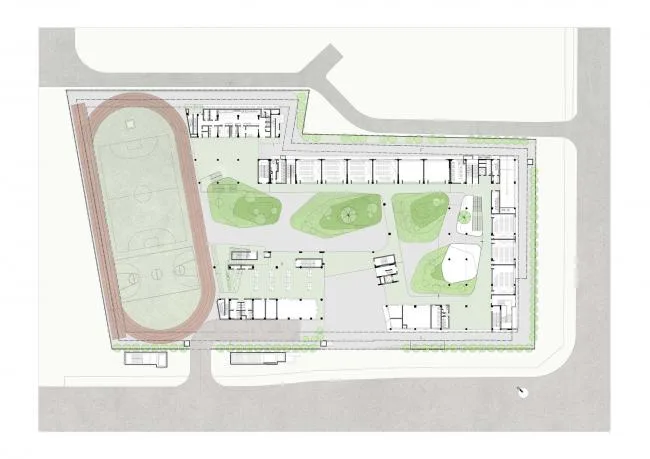
▲ First floor plan
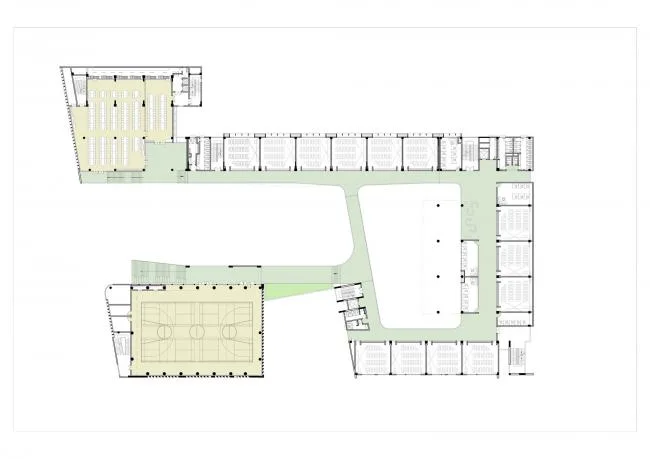
▲ Second floor plan
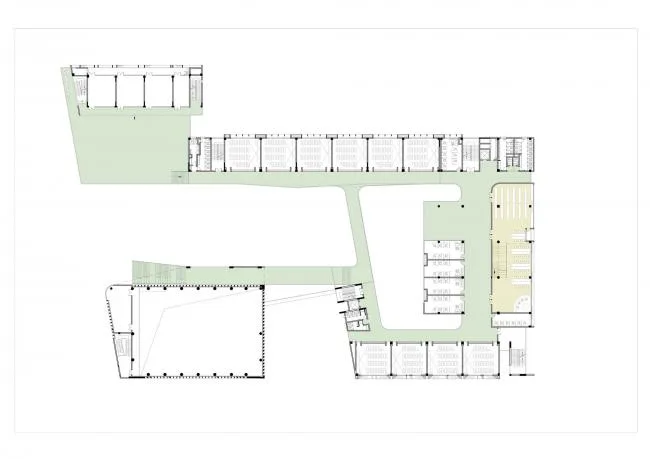
▲ Third floor plan
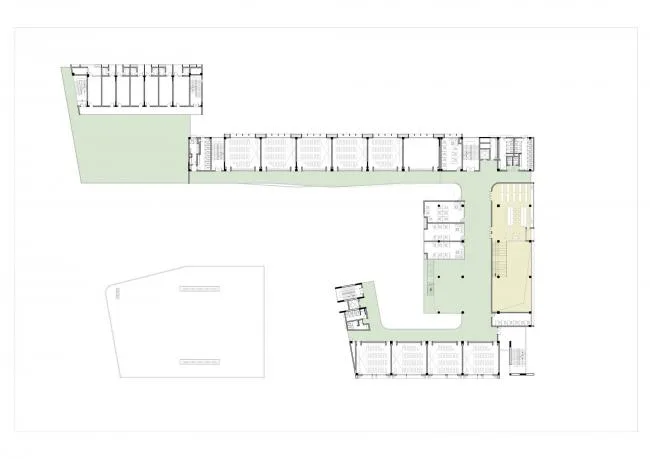
▲ Fourth floor plan
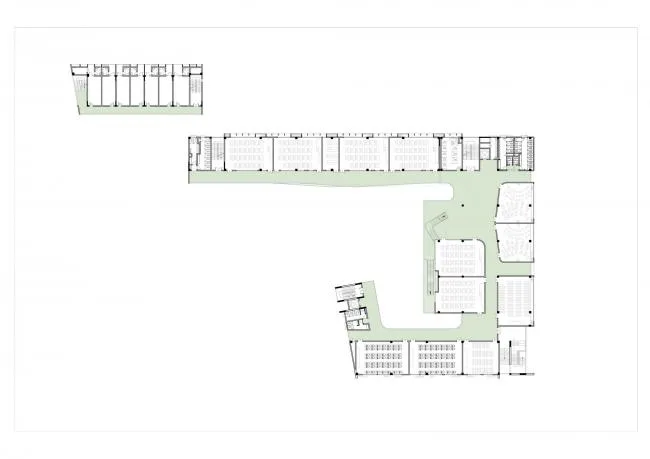
▲ Fifth floor plan
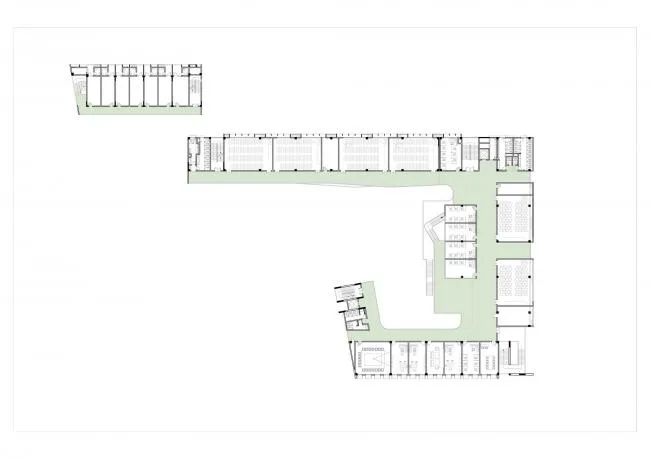
▲ Sixth floor plan
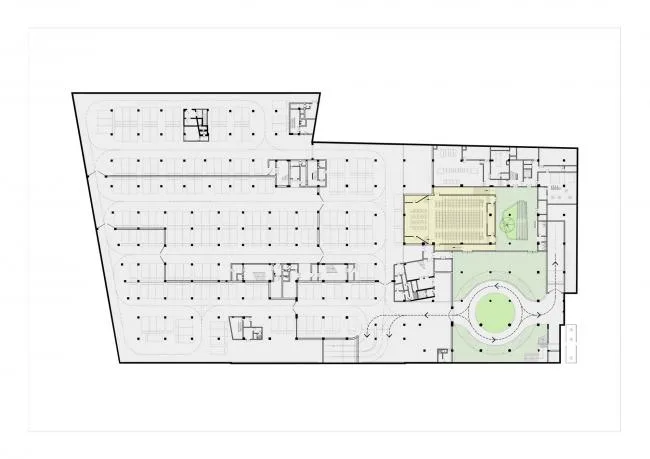
▲ Underground floor plan
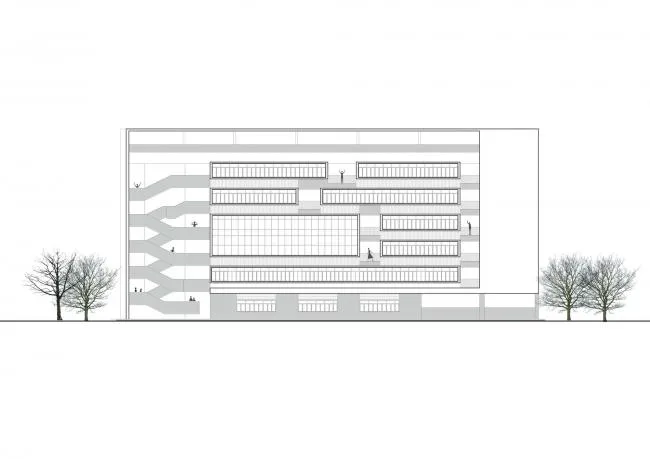
▲ Building façade
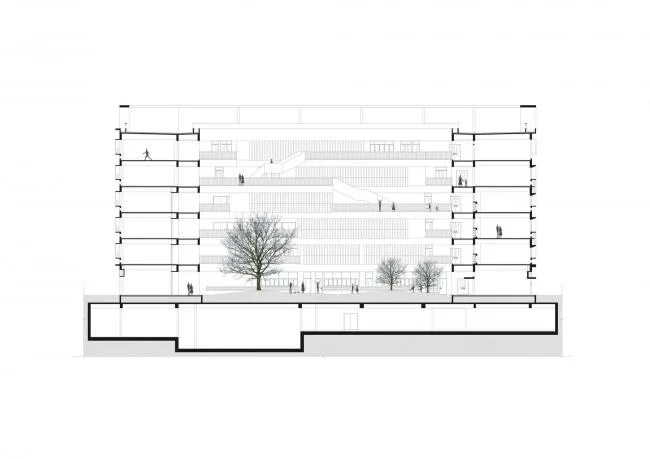
▲ Building section
Project Information
Architectural Firm: Yuanben Studio
Location: Shenzhen, Guangzhou, China
Project Type: Primary and Junior High School
Project Leader: Cai Ruiding
Architectural, Interior, and Landscape Team: Cai Ruiding, Wei Zhe, Huang Runtong, Wu Xiaolong, Wei Xiaochen, Yang Chunping, Li Shanwei, He Weiyong
Construction Drawing Team: Ma Yue, Zeng Xiaona, Liu Chang, Liu Zhongping, Han Kuoyuan, Xie Rong, Tang Jin
Total Building Area: 33,200 m²
Year Completed: 2018
Photographer: Wu Qingshan












Must log in before commenting!
Sign Up